
Shingle roofing · Berkeley
What is the short answer?
Start with the roof and the proposed work
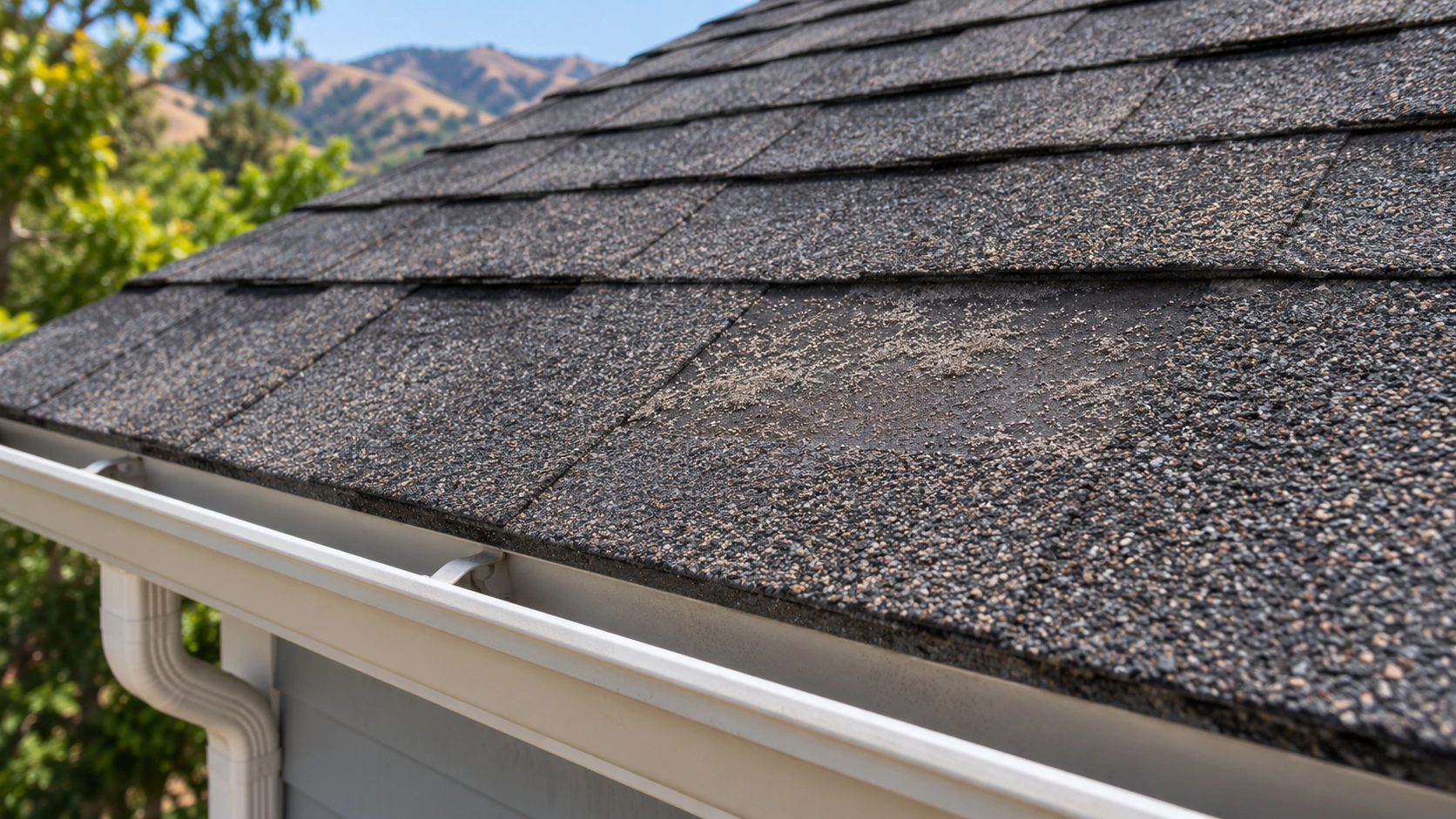
Granule loss does not automatically mean your Berkeley roof needs replacement. The roof’s age, the amount and pattern of loss, other damage and the condition of surrounding components all matter. A professional assessment should distinguish an observation from a diagnosis before a repair or replacement is proposed.
Finding gritty material near a downspout can be unsettling, especially if you recently paid for roofing work. It is still only one piece of evidence. The useful question is whether the condition is limited, changing or accompanied by signs that the roofing material has deteriorated. Avoid deciding from the amount visible in one photograph or after one rainfall.
This guide explains how to prepare for a Berkeley shingle roof assessment and what questions separate a practical repair from a wider project. It complements the Berkeley contractor-selection guide and the Berkeley roof replacement guide. It does not replace an inspection or identify a cause from a gutter sample.
Shingle roofing · Project planning
Why might granules appear around a shingle roof?
Separate loose surface material from broader deterioration
Manufacturer guidance distinguishes some early shedding from excessive or persistent loss. GAF’s bulletin on new shingles explains that extra manufacturing granules may come away after installation. That observation does not mean every gritty gutter is harmless, and it cannot be applied automatically to an older roof. Start by identifying the actual product, installation date and history of the condition.
Ask whether the material was noticed immediately after installation, after a later event or gradually over several seasons. Record the timing without trying to prove a cause yourself. Other roof work, previous repairs and the condition before the observation may help the assessment. Keep existing photos and paperwork so the roofer can compare the account with what is visible now.
Shingle roofing · Project planning
Which observations are most useful before the visit?
Record a pattern without climbing onto the roof
From a safe ground-level position, note where the material appears and whether you can see a particular slope or roof area changing. Indoors, record any new stain and when it first appeared. Mention recent work and weather events as facts, not conclusions. A simple dated record is more useful than labeling the problem as a failed roof before it has been assessed.
Do not brush, scrape or otherwise disturb the shingles to test them. Removing material or walking on the roof can change the evidence and create other problems. Ask the contractor what photographs or documents would help before the appointment. If the roof was recently installed, preserve the invoice and product information so any product-specific question can be directed to the correct party.
Shingle roofing · Project planning
What other signs should a roofer assess?
Look beyond the gutter contents
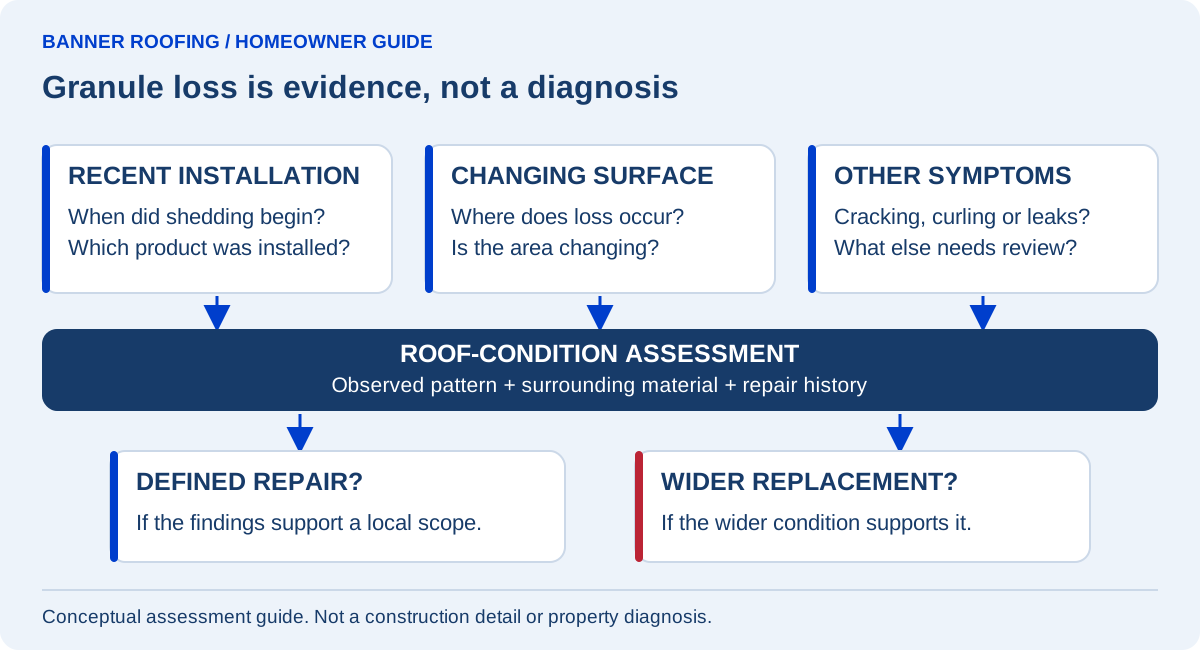
Ask how the assessment considers the distribution of surface loss, the condition of the shingle itself and any other visible deterioration. Curling, cracking, missing material or exposed-looking areas may change the discussion, but none should be interpreted in isolation. The roofer should explain which observations support a recommendation and what remains uncertain about concealed components.
Nearby flashing, penetrations and roof transitions also matter when water intrusion is part of the complaint. A gutter containing granules does not prove that a ceiling stain comes through the same roof area. If the source is unclear, ask whether a separate or more focused leak investigation is appropriate before choosing the repair. Keep surface condition and leak-source findings distinct.
| Observation | Useful question | What it does not prove |
|---|---|---|
| Granules soon after installation | How does the product guidance describe early shedding? | That the roof must be replaced |
| A changing bare-looking area | What does closer assessment show about the shingle? | The cause from one photograph |
| Loss with cracking or curling | How extensive is the surrounding deterioration? | That every slope has the same condition |
| An interior stain | Where is water entering and traveling? | That the gutter contents identify the entry point |
Shingle roofing · Project planning
When might a localized shingle repair still be practical?
Ask about the surrounding material
A limited repair may be worth discussing when a defined problem can be addressed and the adjacent roofing remains suitable for that work. Ask the contractor to explain the proposed boundary, compatible materials and what would remain in place. The recommendation should be based on condition and the ability to complete the repair, rather than the simple fact that one affected area looks small.
Ask what a local repair is intended to accomplish and which observations it will not resolve. It may address a specific defect without changing weathering elsewhere. Appearance matching is also separate from repair suitability. If a repair is proposed, request a scope that distinguishes the affected shingles, related details and any limitations of connecting new work to an existing roof.
Shingle roofing · Project planning
When does the discussion shift toward replacement?
Consider the extent and consequences of deterioration
Replacement deserves a closer discussion when the assessment finds widespread deterioration or conditions that make a dependable localized repair impractical. Ask where those conditions occur and how they were documented. A useful explanation connects the recommendation to the roof as a whole. It should do more than point to granules in a gutter or use the age of the roof as a complete diagnosis.
If two contractors recommend different scopes, ask each to explain the evidence and what the alternative would leave unresolved. That comparison is more useful than asking which company is being more optimistic. Our broader repair-versus-replacement article can help organize those questions, but the decision still needs the findings from your property and an understandable proposal.
Shingle roofing · Project planning
Could the condition involve a product warranty question?
Identify the product and preserve records
If the roof is relatively recent, ask the installing contractor or manufacturer how to document a possible concern. Keep the material identification, installation records and existing photographs together. A manufacturer may have a specific process for evaluating a product claim. Do not assume a visual observation establishes a manufacturing defect or that a warranty covers every cause of surface loss.
A repair decision and a warranty decision answer different questions. Ask whether the roof needs attention now, what evidence should be retained and who should receive the records. This guide does not promise coverage or recommend waiting through an active leak while a product question is reviewed. The appropriate next step depends on the assessed condition and the applicable process.
Shingle roofing · Project planning
How do I request useful help for a Berkeley shingle roof?
Describe the observation and the decision you need
Send the property address, approximate installation date if known and a short description of what changed. Include any earlier repair scope and whether there is water indoors. Mention access arrangements relevant to a visit. You do not need to determine the amount of loss, measure the roof or obtain a close-up from the roof surface before contacting a contractor.
Banner can discuss the available roof repair scope and whether the concern calls for further assessment. For a leak linked to heavy rain, the Berkeley heavy-rain leak guide explains useful timing details. request an assessment and written estimate or call 510.895.4433; ask for a recommendation that explains the observations, practical options and limits of the proposed work.
Shingle roofing · Questions & Answers
Berkeley Shingle Roofing Questions
Does a pile of granules in the gutter prove the roof has failed?
No. It does not identify the age, source, distribution or cause of the material. Share what you observed and when, then ask for a roof-condition assessment. The amount collected in one location is not a substitute for reviewing the shingles and surrounding roof details.
Can a roof with granule loss still be repaired?
Possibly, when the assessed problem is limited and the surrounding roofing can support the proposed repair. Ask what evidence makes that option practical. A repair should have a clear purpose and boundary; it is not a promise to reverse all weathering across the roof.
Is granule shedding normal on a recently installed roof?
Some early shedding is described in manufacturer guidance, but persistent, significant or changing loss deserves a product-specific discussion. Do not generalize one manufacturer’s bulletin to every roof. Have the installation date, product information and photographs ready when asking about your situation.
Should I clean the roof before the contractor sees it?
Ask first. Preserve photographs and avoid disturbing the roofing to demonstrate the problem. Ground-level observations and existing records are enough to start the inquiry. The contractor can explain whether any preparation is helpful and how closer assessment will be arranged.
Who is the best shingle repair contractor near me in Berkeley?
Look for a contractor who explains the findings, distinguishes repair from replacement and provides a written scope appropriate to your roof. Review current licensing information and relevant experience. Compare the quality of the assessment and proposal rather than accepting an unsupported best-in-city label.
Related Roofing Guides
Berkeley · Contractor Guide
Berkeley Roofing Contractor: How Do I Choose the Best Contractor for Shingle Roofing?
Choosing a Berkeley roofing contractor for shingles? Learn how to compare roof assessments, shingle systems, written estimates and installation planning for your home.
Read the guide
Alameda · Roof Repair Advice
Alameda Roof Repair: Can Wind-Damaged Shingles Be Repaired Without Replacing the Roof?
Understand when wind-damaged shingles on an Alameda home may be repairable and what a roofer should assess before recommending full replacement.
Read the guide
Oakland · Shingle roofing
Oakland Shingle Roofing: How Do I Choose Shingles for a Roof Replacement?
Choosing shingles for an Oakland roof replacement? Compare roof suitability, material options, installation scope and warranties before requesting an estimate.
Read the guide
San Leandro · Shingle roofing
San Leandro Shingle Roof Replacement: What Do Material and Workmanship Warranties Cover?
Compare material and workmanship warranties for a San Leandro shingle roof replacement. Learn what to ask about exclusions, registration and claim records.
Read the guide