
Downspout repair · San Leandro
What is the short answer?
Make the decision about your own roof drainage
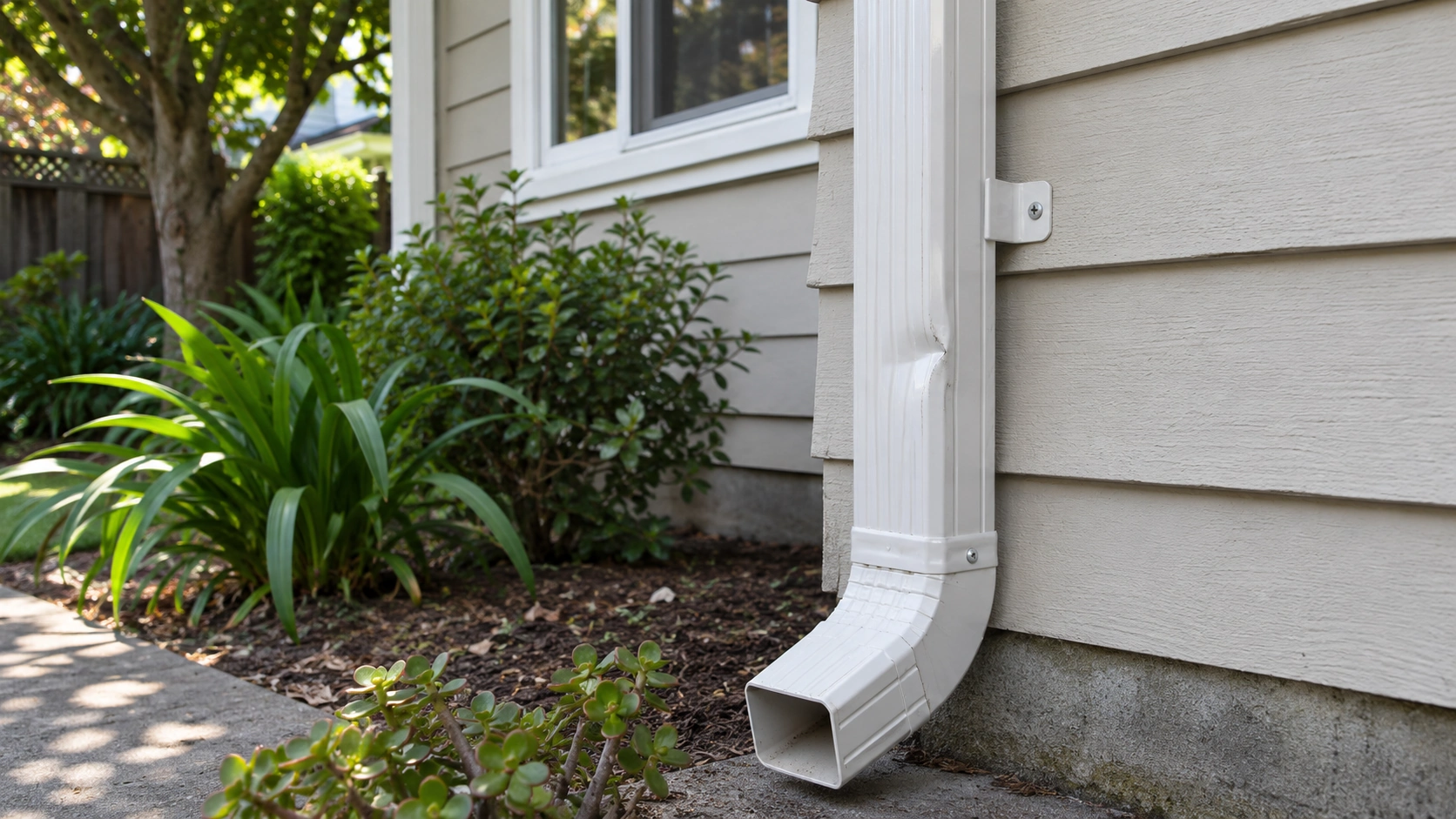
A crushed or detached downspout may be repairable through a defined section or connection replacement when the remaining components are serviceable. The assessment should also explain what caused the damage or movement and whether the outlet, supports and discharge route need attention.
A damaged downspout does not automatically mean every gutter and pipe on the house must be replaced. It does mean the repair should consider more than the visible dent. The connection above it and the supporting surface may affect what will remain dependable.
Begin with Banner’s downspout repair service and the San Leandro roofing contractor guide. Describe the observed damage and ask for a repair boundary that identifies both the work and the parts being retained.
Downspout repair · Record where the problem begins
What does the location of the damage tell me?
Record where the problem begins
Note whether the damage is at the gutter outlet, an elbow, the vertical run, an attachment or the lower end. These are different parts of the route and may need different work. A detached upper connection should not be described as the same problem as a crushed piece near the ground.
Explain how the condition developed if you know. A recent impact, gradual movement or repeated separation after earlier repairs gives the contractor useful history. If the cause is unknown, say that. The assessment should distinguish evidence from a convenient explanation.
Photograph the area from a stable ground-level position. Include a wider view that shows the connected run, not only an extreme close-up of the dent. You are documenting the question for the contractor, not proving that one part is the only affected component.
Downspout repair · Assess the adjoining components
When can a damaged section be replaced?
Assess the adjoining components
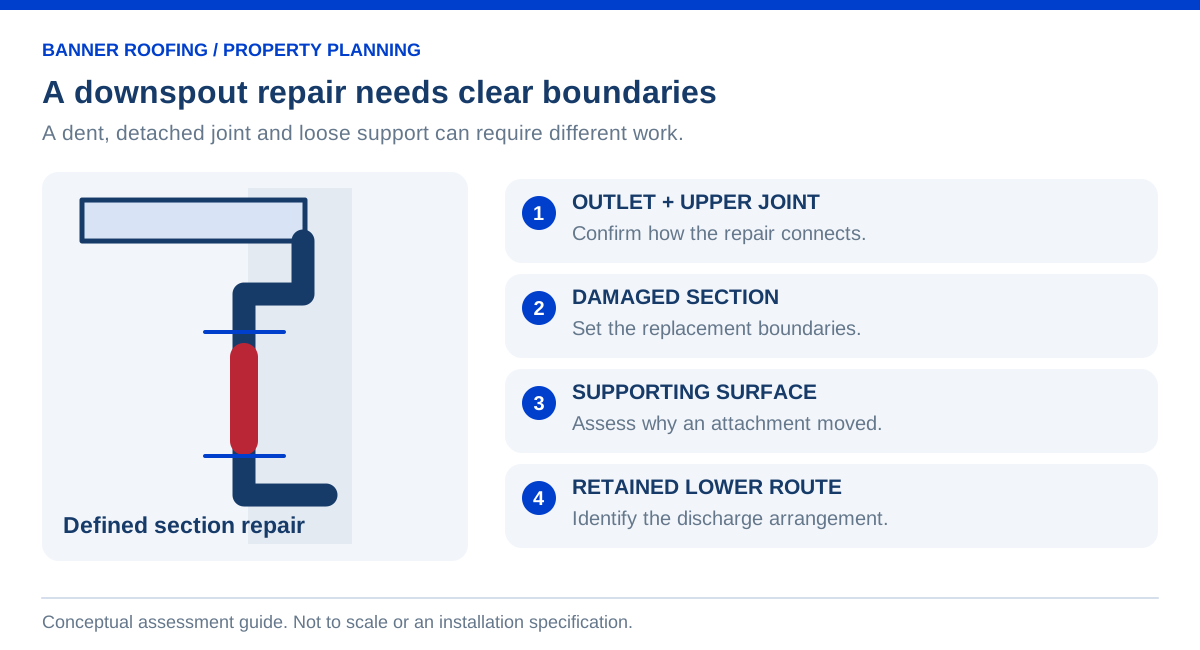
A localized replacement may be practical when suitable connections can be made to serviceable material above and below the affected area. Ask which parts will be removed and how the replacement relates to the retained components. The answer should define the work rather than merely promise to fix the downspout.
The proposed repair may involve an elbow or connection as well as a straight length. An apparently small dent can sit close to a joint, while a longer affected section may have straightforward boundaries. The visible length of damage alone does not determine the most useful scope.
Ask what may change the recommendation during closer assessment. If additional deterioration or a damaged supporting surface is found, how will the contractor explain the options? A clear process for approval is more useful than an estimate that assumes every concealed condition will be sound.
| Observed condition | Assessment question | Possible scope boundary |
|---|---|---|
| Crushed lower section | Are nearby connections sound? | Defined pipe section and fittings |
| Detached upper elbow | What moved and why? | Outlet, elbow and adjacent support |
| Loose wall attachment | Is its supporting surface suitable? | Attachment plus any separate surface work |
| Repeated separation | Is the route under unwanted movement? | Wider connected-route review |
Downspout repair · Do not repair movement with appearance alone
Why should the supports be checked?
Do not repair movement with appearance alone
A downspout depends on an appropriate supporting arrangement along its route. If an attachment has pulled loose, ask about the condition of the surface it connects to. Reattaching a visible band does not settle whether the underlying material can support the proposed repair.
Distinguish the downspout work from any separate wall, trim or structural work. The estimate should say whether supporting-surface repairs are included or need a different scope. That prevents a narrow pipe repair from being mistaken for a complete remedy for surrounding deterioration.
Tell Banner if the same attachment has been repaired before or if the pipe moves against the wall during wind. These details help frame the investigation. Avoid pulling on the pipe to reproduce the movement or assess its strength yourself.
Downspout repair · Look upstream of the visible damage
Does the gutter outlet need attention too?
Look upstream of the visible damage
Ask whether the gutter outlet and upper connection are part of the assessment. A loose or misaligned connection above a damaged pipe may affect the repair choice. Replacing the lower piece while leaving a continuing upstream concern could leave an important part of the problem unresolved.
Also describe what happens during rain. Does water escape at the damaged location, spill from the gutter above or appear behind the pipe? Those observations may involve different paths. Where the last drop falls is useful information, but it does not by itself identify where the water first leaves the intended route.
The federal Building America guidance describes gutters and downspouts as connected components. For this repair decision, ask the contractor to explain how the repaired area will reconnect to the parts that remain rather than considering the damaged piece in isolation.
Downspout repair · Ask what each option resolves
When should I compare repair with a longer replacement?
Ask what each option resolves
Compare a wider replacement if several sections are distorted, connections repeatedly separate or the existing route no longer suits the proposed arrangement. Ask the contractor to explain the findings supporting that recommendation. A wider scope should solve an identified problem rather than serve as a default response to any dent.
A limited repair can still be reasonable when the surrounding components are suitable. Request a clear account of what it resolves and what existing conditions remain outside the work. You can then weigh a smaller defined intervention against a more extensive replacement without treating either choice as automatically superior.
Discuss appearance as well as function. A new section may not exactly match the finish of weathered retained components. Decide whether that difference is acceptable before the work begins, and ask about the actual options available rather than assuming an invisible match is guaranteed.
Downspout repair · Write down the boundaries
What should the repair estimate state?
Write down the boundaries
Look for the damaged locations, proposed replacement pieces, connection changes, attachment work and removal. If the lower endpoint changes, ask the contractor to identify the intended discharge arrangement. A small visible repair should not quietly become an unspecified change to the runoff route.
Ask how completion will be reviewed and which findings you should keep in your home-maintenance record. Before-and-after photos can help you understand what was changed, especially at an upper connection you cannot see clearly from the ground. Keep approved scope changes with the original estimate.
If the pipe connects to an unknown concealed route, identify that as a separate question. Do not assume a downspout repair includes locating or repairing underground drainage. Ask where the work stops and what further assessment would be needed if concerns continue.
Downspout repair · Send useful observations first
How do I request help in San Leandro?
Send useful observations first
Share the property address, a description of the damaged component and whether the pipe is still connected at the top and bottom. Mention recent impact or previous repairs when known. Include a whole-route photo and a closer ground-level image so the contractor can understand the setting.
For broader deterioration, the gutter repair or replacement guide can help organize questions about the connected system. Ask Banner whether the concern belongs within a localized downspout repair or a wider assessment; the city name alone does not establish the answer.
Request a downspout repair assessment or call 510.895.4433. The goal is a defined repair for the damaged location, with compatible connections and clear responsibility for any related work.
Downspout repair · Questions & Answers
San Leandro Downspout Repair Questions
Can a crushed downspout be straightened instead of replaced?
Ask the contractor to assess the shape, connections and resulting condition. A cosmetic improvement does not establish that a section is suitable to retain. Replacement of a defined piece may be more practical in some situations.
Does a detached downspout mean the gutter must be replaced?
Not automatically. The outlet, connections and support need assessment. The gutter may remain serviceable, or related damage may expand the scope. Ask for findings that explain the recommendation.
Can only one downspout section be replaced?
Possibly, when suitable connections can be made to sound retained components. Have the proposal identify the pieces, fittings and attachments involved so the boundary is clear.
Why does my downspout keep pulling away?
Repeated movement deserves a review of the route, connections and supporting surface. More fasteners alone may not address the cause. Share the earlier repair history and ask what the new scope will do differently.
What photos help with a downspout repair request?
Ground-level photos showing the entire visible route, the damaged area and nearby attachments are useful. Include the lower endpoint if visible. Do not climb, disconnect parts or pull on a loose component to obtain a picture.
Related Roofing Guides

San Leandro · Contractor Guide
San Leandro Roofing Contractor: How Do I Choose the Best Contractor for Roof Maintenance?
Compare San Leandro roofing contractors for ongoing roof maintenance. Learn what a useful care plan, written scope and follow-up record should contain.
Read the guide
Castro Valley · downspout repair
Castro Valley Downspout Repair: How Do I Choose the Best Contractor for a Leaking Connection?
A leaking downspout connection needs a clear diagnosis and repair scope. Learn what Castro Valley homeowners should record and compare before hiring help.
Read the guide
San Leandro · roof maintenance
San Leandro Roof Maintenance: How Do I Find the Best Roofer for Ongoing Care?
Build a useful roof-care record for your San Leandro home. Learn what maintenance visits should document and how to separate routine care from repairs.
Read the guide
San Leandro · Shingle roofing
San Leandro Shingle Roof Replacement: What Do Material and Workmanship Warranties Cover?
Compare material and workmanship warranties for a San Leandro shingle roof replacement. Learn what to ask about exclusions, registration and claim records.
Read the guide