

Tile roofing · Castro Valley
What is the short answer?
Start with the roof and the proposed work
Replacing tile-roof underlayment does not necessarily require all-new tiles, but reuse depends on the actual tiles, their condition and the complete proposed assembly. Ask Banner to confirm whether this type of work is within the available scope. An assessment should separate reusable covering from the components that need replacement beneath or around it.
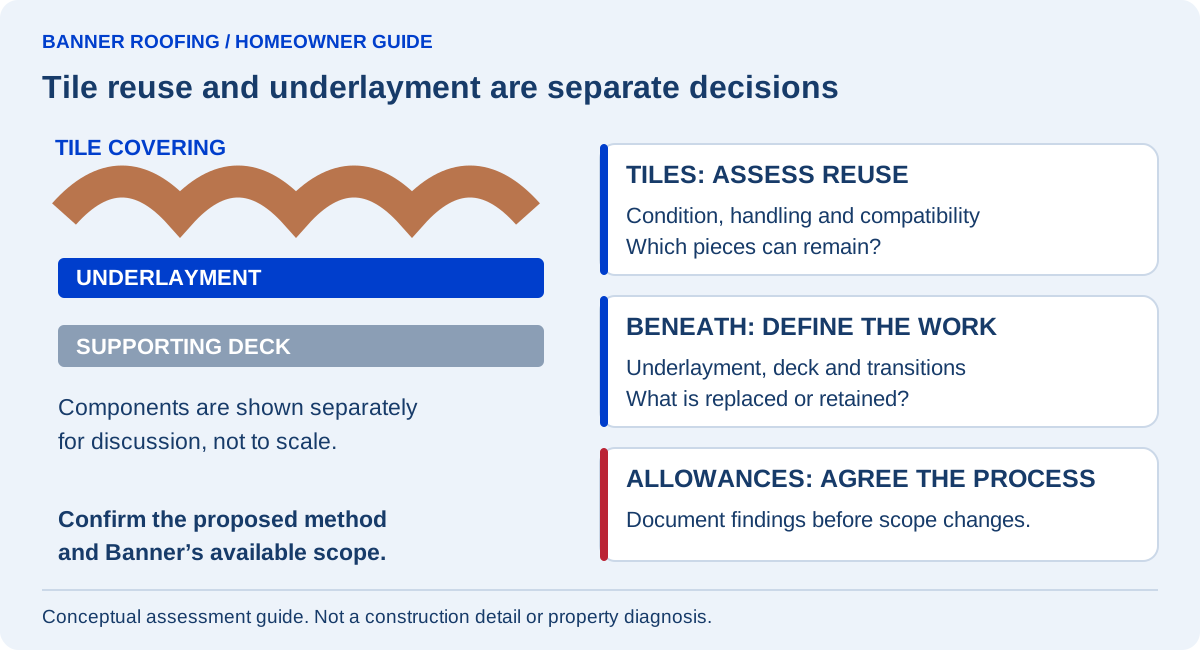
A tile surface can appear intact while the questions about the roofing system sit underneath it. Conversely, visible tile damage does not tell you the condition of every concealed layer. That is why a proposal should describe what was found and which parts of the assembly are being assessed, rather than treating tiles and underlayment as interchangeable terms.
This guide prepares homeowners for a tile roofing assessment in Castro Valley. It focuses on underlayment scope and possible tile reuse, not on instructions for lifting or reinstalling tiles. For visible damage, read the Castro Valley damaged-tile repair guide; for hiring questions, use the Castro Valley contractor guide. Confirm the available work directly before planning around a particular method.
Tile roofing · Project planning
Why can the tiles and underlayment need different work?
Consider the roof as connected components
Tile and underlayment have different roles within the roof assembly. Industry guidance from TRI, published by Eagle Roofing, emphasizes the condition of the secondary water-shedding layer before tile is reinstalled. That supports asking about the system beneath the visible covering. It does not establish that every existing tile roof needs the same work or that the underlayment is the cause of every leak.
Ask the contractor to distinguish observations of the tiles, exposed details and any accessible underlying areas. Find out what can be confirmed before work and what requires further investigation. A useful proposal names the component involved in each recommendation. That prevents a conversation about a few damaged tiles from silently becoming a different project without explaining the evidence.
Tile roofing · Project planning
When might existing roof tiles be suitable for reuse?
Ask for condition and compatibility findings
Reuse is a possibility to assess, not a promise to make from a driveway photograph. Ask how the contractor considers tile condition, the feasibility of handling and the compatibility of any replacement pieces. Discuss whether enough appropriate material is expected to be available for the proposed scope. The answer should reflect your actual roof rather than a general statement that tiles last indefinitely.
Ask what would happen if removal reveals more unsuitable pieces than expected. The proposal should explain how the finding would be documented, how alternatives would be discussed and what approval is needed before the scope changes. A clear allowance or decision process is more helpful than assuming every existing piece will survive handling or match a newly sourced substitute.
Tile roofing · Project planning
What should a tile reuse proposal say about breakage and replacement pieces?
Make the material assumptions explicit
Have the contractor identify which areas are included and how existing tiles are expected to be handled within that scope. Ask whether the proposal includes replacement pieces, how suitability will be established and what happens if an appropriate match is unavailable. Appearance, profile compatibility and condition are separate questions. One answer should not be used to imply that all three have been settled.
If the quote includes an allowance, ask what it represents and how a change would be priced and approved. Avoid comparing an allowance with a fully included amount as though both represent the same commitment. Keep photographs and any identification details available, but leave close handling and assessment to the contractor. A homeowner does not need to remove a sample tile to start the conversation.
| Part of the discussion | Question to ask | Boundary to clarify |
|---|---|---|
| Existing tiles | Which pieces may be suitable for reuse? | Condition and handling assumptions |
| Replacement pieces | How will compatibility and appearance be addressed? | Availability and allowances |
| Underlayment | Which area and assembly are proposed? | Replacement versus retained areas |
| Flashing and deck | What will be assessed or changed? | Included work and concealed findings |
Tile roofing · Project planning
Does new underlayment also mean new flashing or deck work?
Review adjoining components individually
Ask how the proposal treats flashing at walls, penetrations, valleys and roof edges. A new underlayment layer does not by itself explain what happens at every adjoining detail. The contractor should identify retained components and the reason they can remain, as well as any replacement work. This is especially relevant when the original complaint concerns water appearing near a transition.
Deck condition is another separate scope question. Ask what is visible now, what may only become apparent when materials are opened and how additional findings will be handled. Do not assume deck replacement is either always necessary or automatically included. The estimate should make the assessment and approval process understandable so an uncertain condition is not confused with an agreed amount of work.
Tile roofing · Project planning
Can an underlayment project cover only one part of the roof?
Ask how the proposed boundary works
A limited area may be discussed when the assessment supports it, but the boundary needs an explanation. Ask how the work relates to surrounding retained materials and what concerns will remain outside it. The smallest visible stain does not establish the right project size. Water paths, roof transitions and the condition found during assessment can affect what a practical scope looks like.
If a broader area is recommended, ask why a smaller scope would not address the findings. If a smaller area is recommended, ask what it is intended to resolve and how follow-up would be discussed. Both recommendations should stand on evidence. The goal is not to demand the largest or smallest project, but to understand the relationship between the roof condition and proposed work.
Tile roofing · Project planning
Which project arrangements should I discuss before agreeing?
Plan access, protection and documentation
Tell the contractor about occupied rooms, limited side access, gates, landscaping and any shared access that applies to your Castro Valley property. Ask what project arrangements need to be agreed, including material handling, work-area access and cleanup. Do not assume a fixed duration from the roof material alone. The actual scope, weather and conditions found during work can affect the plan.
Ask who will confirm applicable project approvals and inspection requirements for the address. Avoid relying on a requirement copied from another city or an older online article. Have the written scope identify responsibilities and any dependencies. Keep the selected materials, agreed allowances and approved changes together with the estimate so the final record explains what was actually authorized.
Tile roofing · Project planning
How should I request a Castro Valley tile roof assessment?
Describe the concern without choosing the method in advance
Provide the address, tile type if known, repair history and the timing of any leak. Include safe ground-level photographs and previous scopes. If someone has already recommended underlayment work, share that recommendation and ask which findings support it. You can express a preference for retaining suitable tiles while allowing the assessment to establish whether that approach is practical.
Banner’s tile roofing service page is the starting point for scope confirmation. For a concern near a transition, read the Castro Valley flashing-leak guide. Then request an assessment and written estimate, or call 510.895.4433. Ask for separate explanations of the existing tiles, underlayment, flashing and any concealed-condition allowances before deciding how much work to authorize.
Tile roofing · Questions & Answers
Castro Valley Tile Roofing Questions
Does replacing underlayment always mean buying all-new tiles?
No, but suitable tile reuse must be assessed for the actual project. Ask about condition, handling, compatible replacement pieces and the complete assembly. A roof that looks intact from below does not establish how many pieces can remain or what work is required beneath them.
Can Banner provide tile removal and reinstallation for my roof?
Confirm that specific method and scope directly with Banner before planning around it. This guide describes questions to ask about possible tile reuse; it does not establish that every roof, product or underlayment method is within Banner’s available services.
Will an underlayment estimate include replacement flashing?
Ask. The proposal should identify what is replaced, assessed or retained at relevant transitions. Do not infer that all flashing is included from the phrase underlayment replacement, or that existing details can stay without a stated assessment of their condition and suitability.
What if more tiles break or prove unsuitable than expected?
The written proposal should explain the assumptions, any allowance and the process for documenting and approving a change. Ask about replacement-piece availability before committing. An open-ended verbal promise is harder to compare than a clearly described decision and pricing process.
Should I replace underlayment just because the roof is old?
Age is useful history, but it is not a complete diagnosis. Discuss the condition, leak history and relevant findings. Ask why the proposed work is recommended and what alternatives would leave unresolved. The appropriate scope should be tied to the roof, not only to a general age rule.
Related Roofing Guides

Castro Valley · Contractor Guide
Castro Valley Roofing Contractor: How Do I Choose the Best Contractor for Tile Roof Repairs?
Find a Castro Valley roofing contractor for tile roof repairs by comparing assessment findings, underlying components, written scopes and the estimate process.
Read the guide
Berkeley · tile roofing
Berkeley Tile Roofing: How Do I Choose the Best Roofer to Assess the Underlayment?
A Berkeley tile roof can need investigation beneath the visible tiles. Learn how to compare assessment findings, underlayment scope and contractor recommendations.
Read the guide
Castro Valley · roof repair
Castro Valley Roof Repair: How Do I Find the Best Roofer for Damaged Tiles?
Need Castro Valley roof repair for damaged tiles? Learn what to ask about cracked tiles, underlying water protection, leak diagnosis and a written repair scope.
Read the guide
Castro Valley · downspout repair
Castro Valley Downspout Repair: How Do I Choose the Best Contractor for a Leaking Connection?
A leaking downspout connection needs a clear diagnosis and repair scope. Learn what Castro Valley homeowners should record and compare before hiring help.
Read the guide