Commercial roofing · Oakland & Berkeley & Alameda
What is the short answer?
Start with the building and the work you need
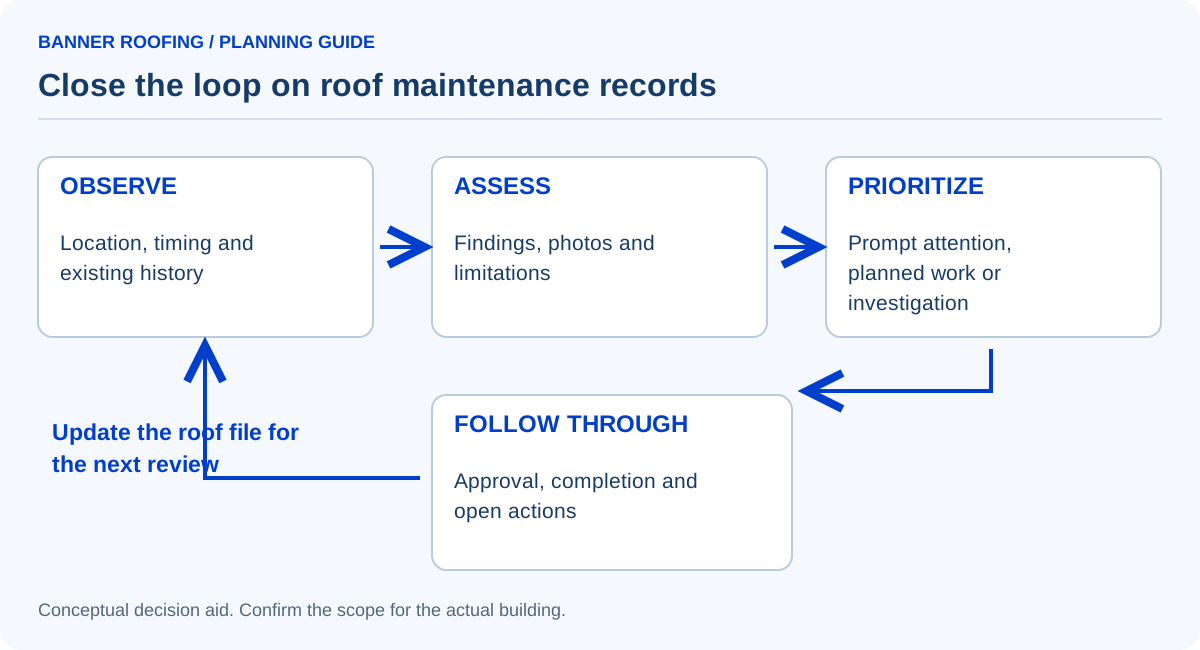
Commercial roof maintenance starts with an organized record of the roof, reported symptoms, observed conditions and follow-up decisions. A useful assessment documents what was reviewed, what was found and which actions need separate approval. Set the review approach using the actual roof system, its condition and applicable owner or manufacturer guidance, rather than assume one schedule fits every East Bay building.
A property manager does not need a roof leak to begin keeping better records. Changes in building use, tenant reports or other rooftop work can provide useful information for the next assessment. The goal is to connect those observations to an appropriate roofing review before scattered notes become the only history available when water appears indoors.
Banner’s commercial roofing service is the place to start a scope discussion. Describe the building and roof system so the team can confirm the available maintenance-related work. This guide explains an owner’s planning process; it does not establish a packaged maintenance contract, a guaranteed prevention program or capability for every commercial roofing system.
Commercial roofing · Project planning
Which records should be in a commercial roof file?
Keep the roof identity and work history together
Start with the property address, building identification and known roof information. Add available installation documents, product information, prior proposals and completed repair records. If the building has distinct roof areas, use consistent names or a simple location map. The person arranging the next visit should be able to identify the area being discussed without relying on an employee who has since left.
Keep the record practical. Store the date, location and description of each reported concern, along with relevant photographs taken safely. Separate a tenant’s observation from the interpretation offered later. When a repair is completed, attach the scope and any approved changes to that specific concern. This makes future comparisons more useful than a folder containing several unexplained photographs and invoices.
Commercial roofing · Project planning
What changes should property staff report between assessments?
Record new information without diagnosing the roof
Ask staff and occupants to report new interior stains, visible water entry or changes around known problem areas through one contact. The report should say where and when the symptom appeared and whether it followed rain or other work. A repeated symptom in the same room is useful history, but it does not prove that the identical roof detail is responsible each time.
Also note work by other trades that may be relevant to rooftop equipment, access routes or building transitions. Share those records with the roofing contractor rather than assume that every later symptom is connected. Staff should not access the roof merely to improve the report. Existing documents, safe indoor observations and information from authorized work visits can provide a useful starting point for professional assessment.
Commercial roofing · Project planning
What should a commercial roof maintenance report document?
Ask for findings that support a decision
Useful reporting identifies the areas reviewed, relevant observations and any limitations of the assessment. Photographs should be tied to locations rather than presented as an unorganized collection. Ask the contractor to distinguish a condition needing routine attention from a finding requiring a separate repair proposal or more investigation. An owner needs to understand the next decision, not only receive a checklist marked complete.
NRCA’s published maintenance guidance discusses documenting roof conditions in writing and photographs so records can be compared over time. Apply that principle to your property file without assuming every assessment includes the same tasks. Ask Banner what the proposed visit covers and what report or follow-up information is available for that scope. A maintenance review does not establish the condition of every concealed component.
| Report element | Useful question | Follow-up record |
|---|---|---|
| Location and observation | Where is the concern and what was observed? | Dated description with a location reference. |
| Scope limitation | What could not be assessed during this visit? | Open question and proposed next step. |
| Recommended work | Is this routine attention or a separate repair? | Written scope or approval request. |
| Completion and recheck | What was done and what remains to monitor? | Closed item or assigned follow-up date. |
Commercial roofing · Project planning
Why should penetrations, edges and drainage be considered together?
Treat the roof as connected details
A commercial roof assessment may need to consider the surface and relevant transitions around equipment, penetrations, walls, perimeter details and drainage. The appropriate attention depends on the roof system and the reported concerns. A symptom in one room is a reason to investigate, not a reliable drawing of the entry point. Ask which connected details were reviewed and what evidence supports a proposed action.
This does not mean every visible mark requires repair or that one service provider handles every connected building system. A mechanical problem, an inaccessible area or separate site-drainage work may fall outside the agreed roofing scope. The Alameda commercial leak guide explains common assessment questions. Use those questions to clarify responsibilities for the actual property, not to select a diagnosis from a list.
Commercial roofing · Project planning
How should a property manager prioritize recommended work?
Separate urgent conditions, approved tasks and open questions
Ask the contractor to explain the reason and practical significance of each recommendation. Identify what requires prompt attention, what can be planned and what needs another assessment before a scope is chosen. The priority should reflect the observed condition and building use. A label such as maintenance does not mean that active water intrusion can be treated as an ordinary future checklist item.
Assign an owner to every follow-up decision. If a proposal needs approval, record who will review it; if access is pending, record who will arrange it. Keep people clear of immediate hazards and obtain suitable qualified help where water affects electrical fixtures or unstable materials. For a reported urgent roof concern, contact Banner directly to discuss the circumstances and availability rather than infer a guaranteed response time.
Commercial roofing · Project planning
How often should our commercial roof be assessed?
Choose a schedule that fits the system and its history
Ask what review interval is appropriate for the actual roof, taking account of its condition, known concerns, occupancy, manufacturer guidance and relevant warranty terms. A building with an established problem may need different follow-up from a roof with a stable documented history. Events or work that change conditions can also create reasons to discuss another assessment outside a routine plan.
Keep the distinction between a planned review and a guarantee clear. Regular attention can support better decisions, but it cannot establish that no leak will occur. Ask what the proposed maintenance-related scope includes, which tasks need separate authorization and how future visits would be arranged. Do not assume that Banner offers a subscription, fixed inspection package or particular interval unless the company confirms those terms.
Commercial roofing · Project planning
How do we start an East Bay commercial maintenance discussion?
Bring the current questions and the existing records
Choose the building or roof area you want to discuss and assemble the available history. Include the address, known roof system, last documented work and any current concerns. Explain access arrangements and identify the manager who can coordinate the visit. If the property file is incomplete, say so. A useful first conversation can establish what information is missing as well as what work may be appropriate.
Explore East Bay service coverage and request a commercial roofing discussion, or call 510.895.4433. For Oakland properties, the Oakland roofing guide offers general hiring context. Ask Banner to confirm system fit and the initial scope, then use the findings to build an organized plan for the building rather than a generic list of tasks.
Commercial roofing · Questions & Answers
East Bay Commercial Roofing Questions
Can maintenance guarantee that a commercial roof will not leak?
No. Maintenance planning and assessment support informed decisions, but they cannot guarantee every future condition or establish the state of inaccessible components. Ask what was reviewed, what remains uncertain and what follow-up is recommended. Keep active symptoms separate from the routine maintenance schedule.
How often should our building’s roof be assessed?
Discuss an interval based on the actual roofing system, condition, history, building use and applicable manufacturer or warranty guidance. New damage, severe weather or relevant rooftop work may prompt a separate review. Confirm the proposed arrangements directly rather than assume every property needs an identical schedule.
Does Banner offer a commercial roof maintenance contract?
The available scope and any ongoing service arrangement must be confirmed directly with Banner. This article explains useful planning questions and does not announce a specific contract, subscription or fixed inspection package. Share your building information and ask what the team can provide for that property.
Should we clean the roof ourselves before an assessment?
Do not send staff onto the roof without appropriate access, knowledge and safety arrangements. Ask the roofing contractor what preparation is needed and whether changing the condition would remove useful evidence. Safe photographs, repair records and symptom notes can be collected without improvising roof access.
What information should we retain after work is completed?
Keep the agreed scope, approved changes, location information and completion records together with relevant product or warranty documents. Record any concerns left open and the person responsible for the next step. A future assessment is easier to interpret when it can be compared with a clear account of earlier work.
Related Roofing Guides
Oakland · Commercial roofing
Oakland Commercial Roofing Contractor: What Should a Commercial Roofing Estimate Include?
Compare commercial roofing estimates in Oakland. Learn what the assessment, work boundaries, allowances, access plan and warranty documents should explain.
Read the guide
Berkeley · Commercial roofing
Berkeley Commercial Roofing Contractor: How Can Roof Work Be Planned Around Tenants and Business Hours?
Plan commercial roofing around Berkeley tenants and business operations. Prepare access details, communication responsibilities and realistic scheduling questions.
Read the guide
Alameda · Commercial roofing
Alameda Commercial Roofing Contractor: How Do I Choose a Roofer for a Storefront or Mixed-Use Building?
Choose commercial roofing help for an Alameda storefront or mixed-use building. Review system fit, owner coordination, assessment records and a clear scope.
Read the guide