Commercial roofing · Berkeley
What is the short answer?
Start with the building and the work you need
Roof work on an occupied commercial building starts with a shared plan for access, people, deliveries and communication. Tell the roofer how the building operates before requesting a schedule. Then agree on responsibilities and contingencies for the actual scope. Banner Roofing should confirm both roof-system suitability and available project arrangements; uninterrupted trading or after-hours work should never be assumed.
A Berkeley property manager may need to coordinate several people before roofing work can start: the owner approving the project, tenants using the building and the contractor assessing the roof. Each sees a different part of the problem. A simple building brief brings those needs together before they become a scheduling disagreement.
This guide focuses on occupied-building planning rather than choosing a material or diagnosing a leak. Begin with Banner’s commercial roofing service and use the Berkeley roofing contractor guide for general selection questions. Confirm Berkeley service coverage and describe the particular building, roof system and operating restrictions in your inquiry.
Commercial roofing · Project planning
What should a roofer know about an occupied building before quoting?
Describe how the property is used throughout the day
Give the contractor a practical description of occupancy: who uses the building, when deliveries arrive and which entrances need attention. An office, a retail unit and a workshop may have different operational constraints even when their roof areas are similar. Identify sensitive workspaces, regular events and any restricted rooms relevant to access. These are facts about your property, not assumptions based on a Berkeley address.
Explain the concern that prompted the work as well. If a ceiling stain affects an occupied room, record the room and the timing of the report. If the inquiry concerns planned replacement, share the available roof records and the owner’s goals. Ask what needs to be assessed before the contractor can discuss suitable work phases, access restrictions or a meaningful project schedule.
Commercial roofing · Project planning
Who should be responsible for decisions and tenant notices?
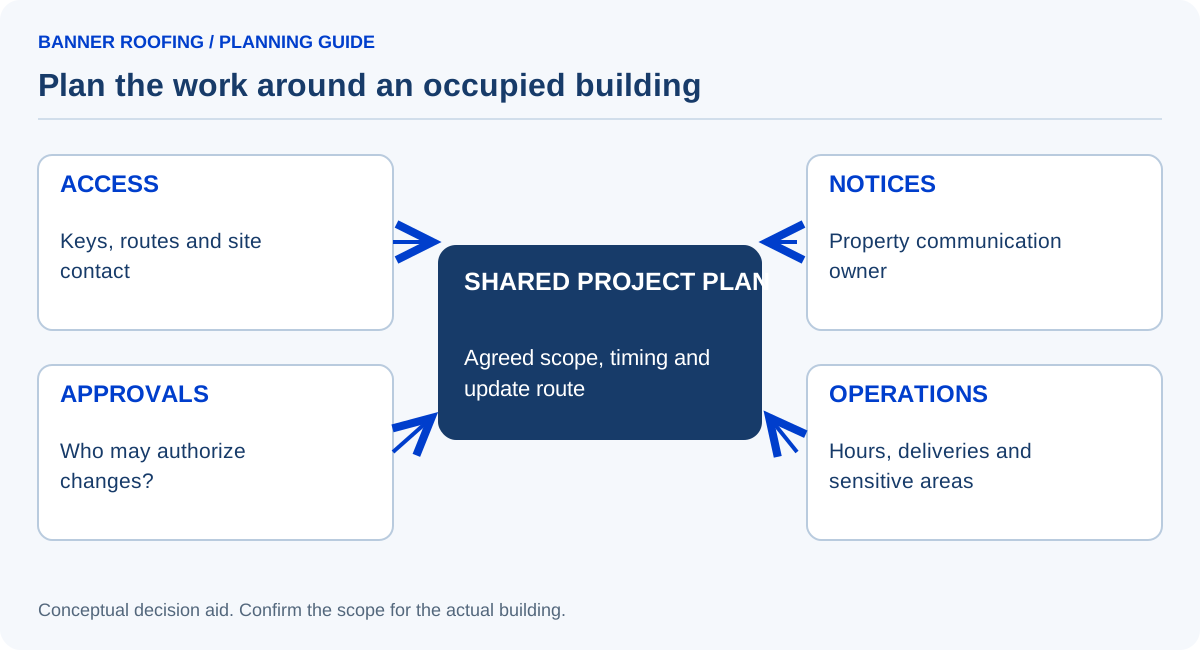
Give each communication a named owner
Nominate one project contact who can collect building information and coordinate with the owner. Separately identify who may approve scope or price changes. The same person may fill both roles, but the contractor should not have to guess. Provide an appropriate backup contact for decisions that cannot wait for the next routine management meeting. Avoid making informal tenant requests a substitute for an authorized instruction.
Agree who prepares tenant notices and how updates are distributed. A contractor can explain the proposed work activities, while the property representative knows the occupants and established communication channels. Ask how much notice is practical and which information remains provisional. Keep a record of the agreed plan so a tenant hearing a revised date receives the same explanation as the building manager.
Commercial roofing · Project planning
How should roof access and ground-level work areas be coordinated?
Review the route, not only the roof surface
Describe access controls, keys, alarms and any areas that cannot be entered without an escort. Ask the contractor to identify the practical route required for assessment and proposed work. A locked roof hatch, a shared passage or a delivery entrance may need advance coordination. Property staff should not improvise access equipment or roof entry simply to speed up an initial visit.
Ground-level arrangements also belong in the conversation. Ask about proposed material deliveries, waste handling and the spaces that may need to be kept available. Tell the contractor about tenant entrances and regular vehicle movements. The contractor must establish the appropriate work controls; the owner’s role is to provide accurate operating information and arrange agreed building cooperation, not to prescribe a construction safety method.
| Building detail | Person to identify | Question before scheduling |
|---|---|---|
| Access and keys | Building access contact | Who can provide the agreed route at the planned time? |
| Tenant updates | Property representative | How will occupants receive changes to the plan? |
| Scope changes | Authorized owner contact | Who can approve a revised proposal? |
| Deliveries and shared areas | Operations contact | Which regular activities need to be coordinated? |
Commercial roofing · Project planning
Can the work be phased around business hours?
Ask what is feasible for the actual scope
Explain the periods when access, noise or other disruption would be most difficult and ask what options are feasible. Phasing may be worth discussing, but the answer depends on the roof, work sequence, weather and the contractor’s availability. A preference for quieter hours is not the same as confirmation that every task can be performed then. Request the proposed arrangements in writing.
Ask what a phase means in practical terms: the area involved, the expected activities and the conditions needed before moving to another area. If one phase depends on another trade or an owner decision, identify that dependency. Do not promise tenants an exact sequence before the contractor has assessed the building and confirmed the plan. A realistic outline is more useful than a reassuring but unsupported timetable.
Commercial roofing · Project planning
What happens if weather or a new finding changes the schedule?
Agree on how the plan will be updated
Before work starts, ask how weather decisions and discovered conditions will be communicated. Identify who receives an update, how it reaches occupants and what information the contractor needs from the property manager. The answer should distinguish an expected working period from a guaranteed completion date. Keep contingency discussions tied to the actual scope rather than assume every commercial project has the same flexibility.
A changed plan may also require a new owner decision. Ask how a concealed-condition finding would be documented and priced, and whether the approval contact will be available. If building operations cannot tolerate a proposed change, raise that constraint promptly so the parties can discuss it. The goal is a shared decision process, not a promise that weather and unexpected conditions will have no effect.
Commercial roofing · Project planning
How should a tenant-reported leak be documented during planning?
Capture useful observations without creating a second hazard
Ask tenants to report the affected room, approximate timing and visible symptoms through the agreed contact. Ground-level photographs and a short description can help establish the history. Separate a new observation from an assumption about its cause. A leak reported near rooftop equipment, for example, does not by itself establish whether the roof detail or another building system is responsible.
If water affects electrical fixtures, unstable ceiling material or occupied circulation areas, keep people away and obtain the appropriate qualified help. The roofing inquiry does not replace management of an immediate building hazard. Share relevant updates with the contractor and ask about availability directly. For additional context, Banner’s heavy-rain leak guide explains why recording the conditions can be useful.
Commercial roofing · Project planning
What should I send Banner Roofing to start the conversation?
Provide the building brief before asking for a firm date
Prepare a short message with the address, building use, known roofing system, symptom or project goal and the main access restrictions. Add the property contact and approval contact if they are different. Share any existing scope documents so Banner can understand whether you want an assessment, a repair proposal or a broader roofing discussion. Ask the team to confirm the type of commercial work it can provide.
Use the contact form to discuss your commercial project or call 510.895.4433. Explain the business-hours concern as a planning requirement, then review the proposed options rather than assume a particular arrangement is available. A useful start leaves everyone clear about the next assessment, who coordinates access and which scheduling questions still need answers.
Commercial roofing · Questions & Answers
Berkeley Commercial Roofing Questions
Can commercial roof work be arranged around business operations?
Discuss the building’s operating hours and constraints before accepting a proposal. Some arrangements may be feasible for a particular scope; others may not. Banner must confirm the work, availability and proposed sequence. Do not assume that a request for minimal disruption guarantees continuous trading or a particular working period.
Does Banner Roofing offer after-hours commercial work?
Availability and working arrangements should be confirmed directly for the specific project. This guide does not establish an after-hours service offer. Share your constraints when requesting the assessment so the team can explain what it can provide before you make commitments to tenants.
Who should tell tenants about roofing work?
Agree on a communication owner in advance, usually through the property’s established management arrangements. The contractor can explain the planned activities and relevant updates, while the property representative knows how to reach occupants. A named process helps prevent different tenants receiving conflicting dates or instructions.
Can my maintenance employee inspect the roof first?
Do not ask an employee to enter the roof without the appropriate access arrangements, knowledge and safety procedures. Useful information can often be gathered from existing documents, tenant reports and safe interior or ground-level observations. Ask the roofing contractor what information is needed and how the assessment should be arranged.
How do I choose a commercial roofing contractor near me in Berkeley?
Look for a contractor that can assess your roof system and explain a clear scope, then discuss the occupied-building arrangements as part of project fit. Verify current contractor information and review written terms. Geographic proximity alone does not establish suitability for the building or the work you need.
Related Roofing Guides

Berkeley · Contractor Guide
Berkeley Roofing Contractor: How Do I Choose the Best Contractor for Shingle Roofing?
Choosing a Berkeley roofing contractor for shingles? Learn how to compare roof assessments, shingle systems, written estimates and installation planning for your home.
Read the guide
Oakland · Commercial roofing
Oakland Commercial Roofing Contractor: What Should a Commercial Roofing Estimate Include?
Compare commercial roofing estimates in Oakland. Learn what the assessment, work boundaries, allowances, access plan and warranty documents should explain.
Read the guide
Alameda · Commercial roofing
Alameda Commercial Roofing Contractor: How Do I Choose a Roofer for a Storefront or Mixed-Use Building?
Choose commercial roofing help for an Alameda storefront or mixed-use building. Review system fit, owner coordination, assessment records and a clear scope.
Read the guide
East Bay · Commercial roofing
East Bay Commercial Roof Maintenance: What Should Property Managers Check Before Small Problems Become Leaks?
Organize commercial roof maintenance in the East Bay. Learn what a useful report should document and how property managers can prioritize follow-up work.
Read the guide